Tuesday, 27 November 2012

Race To Market!!

Due to international trade and green houses the vast majority of fruit and vegetables are available year round so the average person has no knowledge of when these fruits and vegetables are available locally. We have been tasked with creating a game that teaches players when fruits and vegetables are available locally (within Ontario).

We decided to go with a card game as it seemed the most capable of handling the multitude of different fruits and vegetables that are grown within Ontario. We wanted to make the players remember the months in which certain fruits and vegetables are available within Ontario. We wondered how best to do this and decided that the best way would be to make the game fast paced in some way. So that the players would find it in their best interest to memorize when these vegetables and fruits were available. The team decided to make the game about matching the produce to the months in which they are available with a time limit which would drive the players to memorize when vegetables and fruits are available so as to make themselves more  proficient at the game. 

Design wise, we wanted to keep to a simple layout for the card design so as to not take away from the focus on the matching aspect of the game. We wanted players to recognize right away the things depicted on the cards so we decided to go with a white background and a solitary image of the fruit or vegetable in the center with its corresponding name underneath. The design is the same for the months only that they just a say a month, the months run from May to December as the fruits and vegetables we have chosen for the game are available within those months. 

Hopefully this game teaches players when Ontario produce is available fresh and bring recognition to the farming industry within Ontario. 

Game Pieces:
  • 1 x Produce table
  • 1 x Produce/Month card deck (60 cards)

Set Up:
  1.         Shuffle the deck
  2.          Deal out 5 cards to each player
  3.          Place the rest of the cards face down in the center of the four players and spread them out to make a pile
  4.          A timer is set for 5 minutes, or shorter for a higher difficulty.                                                                                         


-          Game Play


  •      There are no turns; all players begin at the same time the timer is started.
  •           Players must match the cards of the fruits and vegetables to the cards of the months of which these fruits and vegetables are available.
  •           A fruit or vegetable card can only be matched to one month card and vice versa.
  •           When a match is made, those cards are placed in front of that player face up.
  •          A player may take a card from the pile and place it in their hand at any time
  •           A player may also discard a card at any time but must then draw two cards.
  •           The goal is to match all the cards in your hand before the timer runs out. 

Friday, 23 November 2012

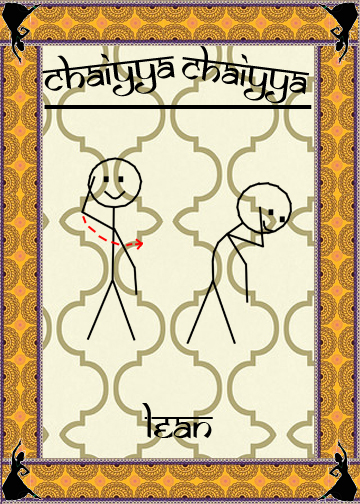
Party! Chaiya ChaiYEAH!

The team, Jazz and Awol, and I have recently been called upon to create a party game revolving around the a certain scene in the Bollywood movie, Dil Se. the scene is more commonly know the Chaiya Chaiya scene.
The scene involves a man and a woman singing to each other all the while they and just about everyone else with them is dancing on top of a moving train as it travels through the country of india. We discussed what made a game a party game and came to a conclusion that a good party game involved the possibility of a lot of players, a lot of interaction, and quick pacing. We then discuss how best to to incorporate the the elements provided by the the chaiya chaiya scene and incorporate them successfully into our definition of a good party game.

Initially, we came up with the idea that players would perform for the other players, either dance or sing or whatnot. But the goal was to perform badly, so badly that the other players would throw tokens at the performing player to make them stop and that the person with the most tokens at the end of the game wins.

But this idea didn't sit too well with me. I like the idea of players performing silly things for others but i don't like how the focus is on bad performance and how much of it players can take. Performing badly in front of others may be a little embarrassing, annoying, even a little amusing but I doubt it is enough to FORCE players to give you their tokens. So the performing player must keep performing worse and worse until they cross the line and resort to screaming and even invading the personal space of players just to make them flinch . This not ok for a party especially if its between complete strangers. So ultimately we scrapped that idea.

Our second idea more closely adheres to the elements of chaiya chaiya by having the game revolve around dancing. All the players must dance to the chaiya chaiya song according to cards drawn by ta dealer. every turn the dealer draws a card  and the dance becomes longer by one dance move, which is depicted on the cards. When players make mistakes they are out of the game and join the dealer in keeping an eye on the other players making sure they they get kicked out of the game when they make a mistake. So the game revolves around players dancing this silly random dance. We liked it and decided to go with it.

We decided to go with a deck of cards as oppose to a spinner because with a deck of cards it is easy to keep track of which moves are to be performed next where a spinner requires an outside material to keep track of its outcomes. The split the concentration of the players as they not only have to memorize the dance moves but also keep track of the beat of the song as well as keep an eye on the other players just in case they can call them on losing. This makes players prone to making mistakes, and it only gets harder as the dance gets longer and longer with every turn.

We had a hard time coming up with what to call our game. The title still had to tie into chaiya chaiya yet be different enough not to have exactly "chaiya chaiya" in it. The one of our friends suggested the name "Chaiya ChaiYEAH!" and it just stuck.

Game Set:

-          Dance move card deck
-          Chaiya chaiya music CD
-          Cd player and speakers (not included)

Game Rules:
  1.  Place CD in CD player
  2.   The group of players decides who of the group will become the dealer
  3.    The dealer shuffles the card deck and places it face down in front of him/her
  4.     The rest of the players line up side by side, at arm’s length away from each other, in a semicircle in front of the dealer.
  5.     The dealer then draws a card and places it face up in front of him/her
  6.     The dealer then demonstrates the dance move depicted on the card in front of the other players
  7.      The dealer then starts the music from the beginning
  8.     The players start to dance on the 4th beat after the beats begin in the song
  9.      The players then dance the move on the card while keeping to the beat of the music
  10.   When the move has been performed the turn is over
  11.    Repeat from step 5

Additional Rules
  •        All proceeding cards after the first card is placed to the right of the previous card drawn
  •        The players must perform all the moves in the face up cards in the right order
  •        The players must keep to the beat of song while dancing
  •        If a player does not keep to the beat they are out of the game
  •        If a player does not perform the dance moves correctly, they are out of the game
  •        The job of the dealer is not only to draw cards and demonstrate the dance moves but to also watch the other players and kicking them out of the game should they not follow the beat or perform incorrectly
  •        A player wins when they are the last player standing 


Tuesday, 6 November 2012

A Wonderful Rogue

This is an interview between my character, James Alexander Filigree, and an independent reporter who just so happens to be named after me.

James typically wears a cotton button up shirt with the sleeves rolled up to his elbows. The shirt is tucked into a pair of black wool pants which are held up by black suspenders. Over the shirt, he wears a black silk vest with a gold pocket watch and chain tucked in its pocket. He is also often seen wearing black leather gloves.

So without further ado, let the interview begin.

Jonathan:    Hello, my name is Jonathan and thank you for taking time to see me for a interview. I have heard you name passed around a few times but just for the record what is your name?

Filigree:   My name is James Alexander Filigree, I am a man of 22 years and... hmm... there was a fancy word for it.... hmm....oh yes, that's right... Caucasian.

Filigree:   Is there anything else?

Jonathan:   Oh no no we will start the more serious questions now.

Jonathan: Oh bugger, I forgot to write down the date, do you happen to remember what the date is today?

Filigree: Yes, it is November 9th,1875.

Jonathan: Ah, thank you. Now that everything is finally in order, lets begin.

Jonathan: Where were you born, Mr. Filigree?

Filigree:   Mind you, due to the manner of which I came to inhabit this isle I can not be sure as to where exactly I was born, though from what little i could find I know that I was born somewhere during the journey from Paris, France to London, England.

Jonathan:   That seems like quite the trip for an infant, what did your parents think?

Filigree:  They're dead.

Jonathan: Are they still alive?

Filigree: ...didn't i just say they were dead?

Jonathan: Where, if i may ask, do...umm... where do they lay?

Filigree: somewhere at the bottom of the English Channel, I think.

Jonathan: What?!

Filigree: Well, I told you that I was born while traveling from Paris to London correct?

Jonathan: Yes, of course.

Filigree: Well, in order to reach London you must first cross the English Channel. I have my doubts that my former parents were able to purchase space on those large ocean faring ships and instead chose the more economical choice, to their undoing, as I'm sure that the day they embarked  was a particularly stormy day.

Jonathan: But how did you survive?

Filigree: Luck! Good sir. Blind bloody luck! You see, when I was born  my parents had the good sense to purchase some sort of covered basket to put me in, and it just so happened that that basket floats. Though how I got shore is nothing short of miraculous.

Jonathan: What happened after that?

Filigree: Well I washed up onto the shores of Brighton, and there I was found by a Madam Archer, the owner of a relatively well know bordello, here in London. Whom, out of the goodness of her own heart, took me in and raised me as her own.

Jonathan: hmm... I wonder, what was Madam Archer doing in Brighton when her business was in London?

Filigree: hahahaha! Yes well... Whenever I asked her that, she would say that she was on vacation! But I am pretty sure that the only reason she was there was to recruit new girls for the business. hahaha!

Jonathan:  Must have been hard for you while growning up.

Filigree: You do remember the part where I said I was raised by a Madam and her girls right? So of course it was! Don't think that they mistreated me or anything like that, they raised me as their own and I love them as my mother and aunts. I had quite the "colourful" upbringing, as I learned quite a number of things from not only the girls at the brothel but from their patrons as well.They were eager to teach when they were "satisfied" and in a good mood. Much of what I learned was absolutely necessary for my current occupation. 

Though not all of it was good, my mother wanted me to get something of an education and so sent me to school. You can imagine how the other children treated me when they found out that I was raised by prostitutes. It was then that I learned how to defend myself, and defend myself well.

Jonathan:After all that's happened, do you believe in any religion?

Filigree: well I was raised protestant, but honestly i don't know how anyone could adhere to that hogwash


Jonathan: At a glance how do people stereotype you?

Filigree: well I would like to believe that people see me as a common bloke making his way in the world. But, as you can see (gesturing to a gold pocket watch and chain)… my occupation is incredibly lucrative and hence have taken part in some of the privileges of the rich. Which do not really fit the image of the common man.

Jonathan: do you have a romantic partner?

Filigree: Sigh… no…. no I do not. But regardless of whether I had one or not, I would not tell you.

Jonathan: Why?

Filigree: Because, my good man, my occupation, though lucrative, is very dangerous and has a tendency of making people rather cross with me.

Jonathan: So you wish to spare them from being used to get to you.

Filigree: Precisely.

Jonathan: Surprising... I didn't think of you as the noble type.

Filigree: Hmmpff!

Jonathan: Oh! I’m sorry; I didn't mean to insult you.

Filigree: No, of course not.

Jonathan: well, instead of a lover, how about a best friend? Do you have a best friend?

Filigree: Yes, I do. But due to the same reasons as before I cannot divulge that such sensitive information.

Jonathan: Oh don’t be like that. At least tell me what they are like.

Filigree: Well… (his eyes drift to some distant part of the room, focusing on nothing in particular. A small smile upon his face). She is... like fire, beautiful and warm as a well lit fireplace, yet can be as fiery destructive as the most hottest infernos. 

Filigree: (focusing once more as if coming out of a trance) Quite frankly, she is and annoying woman who does not seem to know the meaning of "no" and "go away!". 

Filigree: (Once again, looking off into the distance) And yet.... I cannot see my life without her. 

Jonathan: Could it be that there was a lover after all? 

Filigree: (Looks at Jonathan with eyes showing slightly veiled anger) ....

Jonathan: Umm... moving on....What is your economic situation?

Filigree: I do not like publicizing my "economic situation" as you put it, it's bad for business.

Jonathan: But... before you said... sigh. You have often mentioned you "occupation", what is your occupation?

 Filigree: Lets just say I provide a service to those looking to... "relieve" others of their unneeded goods, if you know what I mean. heh heh heh

Jonathan: Would you steal?

Filigree: Obviously, you didn't know what I meant.

Jonathan: How do you feel about lying?

Filigree: I feel absolutely awful about it. I would never lie. I am a very honest man. really.

Jonathan: Do you have any other vices?      

Filigree: What man doesn't ?

Jonathan: What makes you happy?

Filigree: What makes ANY man happy? what IS happiness? can any one of us ever truly obtain it? But if you ask me, a nice sum of money, a high class whore, and some wonderful wine seem to do the job quite well. hahaha

Jonathan: Then what makes you unhappy?

Filigree: (His eyes wander once more, his mind drifting to some other... to some other person) Losing something valuable. 

Jonathan: What is the one secret that no one must know about you?

Filigree: If I told you it wouldn't be a secret now would it? hahaha And if I did tell you I'd cut your tongue out and nail it to your head.

Jonathan: ...uh

Filigree: (a sinister smile creeps across his face)

Jonathan: Are...Are you afraid to die?

Filigree: Die? no. Leaving things unfinished or unfulfilled, yes.

Jonathan You must be afraid of something, a phobia perhaps?

Filigree: Hmm... not that I know of, no. But then again, I have always felt uneasy around water. I mean, I'll touch the stuff, I even know how to swim. But I have always felt a little off whenever I am around it.

Jonathan: Are you quick tempered? or patient?

Filigree: HAHAHAHAHAHA! I'm sorry, I was just laughing at how droll that question was. My good sir, if I was quick tempered, you would already be on the floor basting in your own blood! HAHAHAHA!

Jonathan: Oh...um... colourful. Well that concludes our interview. Thank you once more Mr. Filigree for taking the time to see me... and for not...umm....basting me in my own blood as you say. 

Jonathan: (He shakes Mr. Filigree's hand, packs up his things and turns away towards the door is about to leave the room when he notices that he feels lighter. Patting himself down to find what was missing) Umm... I appear to have misplaced my wallet... Mr. Filigree have you, per chance, seen it anywhere? 

Jonathan: (Turning around only to see an empty room) Mr. Filigree? 

Wednesday, 31 October 2012

Tic Tactician!

A new and improved version of the classic game of Tic Tac Toe! The game revolves around the core idea of Tic Tac Toe where there are two sets of markers representing the two players in the game. The players then proceed to take turns placing their markers onto a 3x3 space board trying to create a row of 3 before their opponent. In Tic Tactician, some mechanics were added with the intent of creating a new challenging experience for the players. These mechanics include:


  • Power of The Dice - A D6 is introduced into the game, where 3 of the 6 sides dictate what you do during your turn either it be placing 2 markers instead of one, or removing one of your opponent's markers, or removing one of your own markers. The other 3 sides allow you to place markers as usual. This not only adds luck to the game but also adds to the strategic characteristics of the game as players must now decide which markers to remove or where to place their markers. 
  • Bigger Board - The original board of Tic Tac Toe is a 3x3 space board. This is somewhat unfair as the center space provides the most combinations for creating a row of markers and therefore the most valuable. Now, this wouldn't be a problem if both players had a chance at the center space but since the game is turn based, it is always the first player who takes the space. Even if the space is not a part of their strategy, they will take it just to deny the other player of having it. So, to deal with this problem the board has been increased in size to 4x4 space board so that there no longer exists a center space and there is no single space that provides a significant advantage over one's opponent. Of course, with a board this size the players must now create a row of 4 markers as oppose to a row of 3. This not only levels the playing field to allow for more balanced play between players but it also also provides more places to create rows adding to the strategic elements withing the game.
Pieces
  • X pieces x16
  • O pieces x16
  • 4x4 space board  x1
  • D6 x1
Number of Players: 2 

Setup

  1. The board and the dice are placed in front of both players, where they are easily accessible to both players. 
  2. Players choose which set of pieces they want. One player being the X and one being the O. 

The Rules

  1. Players decide who goes first. 
  2. The player taking their turn rolls the D6 and must follow what the outcome of the dice dictates. See Dice
  3. After the player has finished it is now the other player's turn. Repeat from step 2. 
  4. The game continues until either a player has created a row of 4 of their respective marker, in which case that player wins, or all the spaced on the board have been filled (cat's game).
Dice

The outcome of the dice determines what a player does during their turn. 

Outcomes:
  • 2 - player removes 1 of their own markers from the board. If there no markers for the player to remove, that player does nothing for their turn. 
  • 4 - player places 2 markers as oppose to just 1 for their turn. Player MUST place 2. 
  • 6 - player removes 1 of their opponent's markers from the board. If there are no markers for the player to remove then that player does nothing for their turn.
  • 1,3,5 - player places 1 marker onto the board. 
Additional Rules
  • Players can only place markers on spaces where there is no marker currently places there. The space must be empty.
Play Test 

During play testing i found that the play time for the game was greatly extended as markers were constantly being removed from the board, sometimes almost completely clearing it. This allowed for players to replace their markers in different ways trying to achieve victory. The "place 2 marker" mechanic definitely gives the players an advantage but not so much so that it breaks the game as this mechanic is evened out by the fact that the other player can achieve this too as well as remove their markers from the board. Originally the game was played on the original 3x3 board and although it still had the prolonged game play, the "place 2 markers" mechanic was too powerful and the players became focused on obtaining the center space. So increasing the board size to the 4x4 board was definitely the way to go as it provided many more ways to achieve victory and no one space was more power than the others.

Alpha-Male 2!

Alpha-Male! was designed by me, Jonathan Virly. It was the first board game I designed for the Game Design and Production tutorials. The game revolved around the idea of a pack of wolves attacking a defenseless family wandering through the woods where the pack's leader, the alpha male, was killed and now the members of the pack must compete to determine who will take his place.

In the original game each player had a wolf piece and would move their wolf piece around a circular track all the while collecting alpha tokens, each space the players landed on could give them tokens, take them away, or affect what space they or their opponents land on. When a player reaches a certain number of tokens, as decided by a dice roll, they must land on the finishing space to win.

The game was very much dependent on dice rolls, not only did dice rolls decide how many tokens the players needed to collect but also whether or not they would win. So as a change to the game all aspects of randomness was removed from the game and replaced with mechanics that promoted more skill based play.


The game is played as such: 

  1. All players begin on the starting space. 
  2. Players must have a minimum of 10 alpha points before the end square becomes available to them.
  3. Player with the orange marker goes first.
  4. The players then spend alpha tokens to determine how far they can move, each alpha token paid gives one space moving clockwise around the board, unless effected by "interference". See interference. 
  5. All instructions on the space landed on must be carried out. 
  6. The game is won when a player with the correct number of alpha-points lands on the end space. 
Interference
  • Head-butting/Lunging: a player can pay 3 alpha-points to “push” either another player’s or one’s own piece to go one square farther than their movement roll indicates. 
  • Tail Biting / Backtracking: A player can pay 3 alpha-points to “pull” either another player’s piece or your own which decreases the movement phase.
  • These techniques must be called out after a player rolls for movement but before they reach their designated square. It must be spontaneous, no planning allowed.
  • A player may only choose to play ONE of these moves at a time per turn ( this includes the other players as well). Example: Jimmy CANNOT lunge 3 times on his turn but he CAN lunge on his turn then tail bite on Gary's turn.
  • There is no limit to the number of players who can use these moves at one time. Example: Gary pays 6  tokens but before Gary can move 6 spaces Timmy calls tail bite, Cindy calls head-butt, and Jimmy calls tail bite (6-1+1-1=5). So now Gary moves 5 spaces. 
Additional Rules
  • All players start the game with 10 alpha-points.
  • Should a player land on the end square and does NOT have the required number of alpha-points then the end square does nothing and the player must continue around the track. 
  • The players must land on the end space EXACTLY. If your movement role dictates that you pass over the end space then you must continue around the track.
  • When a player runs out of tokens they are out of the game.
  • When only one player is left within the game, that player is the winner.
As one can see by the rules the game has been changed from focusing on dice rolls to more resource management as one must pay tokens in order to move around the board and obtain more tokens but at the same time one must not spend too much, else they run out of tokens. At the same time you can tamper with other people progression but this comes at a cost but can very well ensure that a player gets knocked out of the game. 

Playtest 

Immediately I found that I had to change some of the instructions on the board as they involved instructions about dice rolls, which of course was taken out of the game entirely, they were replaced with instructions using tokens paid instead of dice rolls but the affects of the space remained the same. Further testing revealed that additional instructions on the board spaced need tweaking as the punishments for some of the spots was too severe, knocking players out of the game early on as they did not posses many tokens in the beginning. Other than that I found there was a good level of resource management but i would have like to have seen more interaction , or "interference", between players, so the cost for interfering with other players was decreased. 

Friday, 26 October 2012

Light and Darkness Cascading in a Flurry of Colour


Our team, Jazz and Awol, have come up with a game called Duality. The game revolves around the concept of the Van Gogh painting "Starry Night" and its tossing and turning look and the flux between light and dark. We wanted to try to create a game that addressed this and made the players take part in it by allowing them to examine a piece of art and giving them the chance to express their opinions on the nature of the piece. We felt that competitiveness took away from the focus of the game, which was the swirling duality of light and dark and the player's examination of it, as the players would care less for the art and more towards winning should there be a competitive aspect to the game. So instead we decided to have the players work cooperatively which slowed down the game for the players to fully take part in examining the art and expressing their ideals while at the same time kept them rooted in the game so that the game doesn't become arbitrary or "floaty". There are a couple of mechanics within the game that change, or attempt to, change the alignment of the pieces of art forcing the players to thing in new of seeing the art and forcing them to dig deeper into their imaginations.

The Game Contents:
- Bag of light/dark tokens
- Binary Dice
- Art cards
- Duality board

Players: 2- 6

Gameplay:

1) Shuffle the art cards and place them in the center of the board
2) Choose a player to act as the Dealer, usually the youngest among the players.
3) Dealer then draws a card, presenting both sides of the card to the other players.
4) A Player then rolls the binary dice, players then decide which side of the card best matches the result of the dice.
5) When it is decided which side best matches, the card is placed that face up, on its corresponding side.
6) The Dealer then turns his/her back to the other players and the other players then examin the card and write one word on a piece of paper reflecting their feeling they get from the card. Players are not alowed to talk during this stage.
7) The scraps of paper are then put into a pile on top of the card.
8) the Dealer turns around and must now guess who wrote what
9) for every right guess the dealer places one token of the corresponding colour into its pile.
10) the player to the right is now the Dealer.
11)The players must try to keep the number of tokens in each pile even, should one pile grow 7 tokens bigger than the other the players lose.
12) When each pile has a number of tokens equal to double the number of players, the players win.

Tuesday, 16 October 2012

Liar's Dice: Alternative Roll!

The Positive Feedback Loop

After a few playthroughs it became evident that the positive feedback loop was that every time you bet correctly or call out another player correctly, making them lose a dice, it becomes easier to continue betting/calling out correctly as the number of possible outcomes for the collective dice rolls decreases and therefore making it easier to predict. It doesn't even matter if you are the one who loses a dice because as long as SOMEONE is losing dice the possible outcomes becomes easier and easier to predict as the number of the possible roll combinations decreases with every dice lost.

Below, you will find the original rules as well as a modification to said rules. This modification, call hubris, is geared towards counteracting the innate positive feedback loop of the original game. Hubris, essentially, forces a player to reveal a dice on all subsequent dice rolls every time they win their bet. The number of dice they are forced to reveal increases every time they win their bet. This makes it harder for winning players to lie and easier for losing players to call their bluff. 

Original Rules


1) all players roll dice in their cups

2) players look at their dice roll, taking care to keep it concealed from the other players

3) the first player then bets on how many of a certain dice outcome has occurred in all the dice rolled between all the players.

   Example: Jim rolls his dice, and he rolls one 2, one 3, and three 5s. Jim is also the first player and bets that there are
 at least three 5s in the group, meaning that out of ALL the dice outcomes of all the players there are at least three
 5s.


4) The next player can then increasing the bet placed by the
previous player (See Increasing Bet). 


   Example: Gander takes his turn after Jim, so he has the choice of either increasing the bet of Jim OR calling Jim out on his bet.

5) Players can Call Out another player on their bid (See Callin'em Out) after the bid has been made. Players can only call out another player on their bid from the time the bid has been made to the time the next player takes their turn.

6) When a player loses all their dice they are out of the game.

         
Increasing Bet:

 A player who chooses to increase the bet of the previous player may do so by increasing the amount of the   certain outcome
they named, OR increasing the outcome named, OR both.


Example: Jim bet that there was at least three 5s. So Gander can bet that there are FOUR 5s, or three 6s, or four 6s.

Calling'em Out:

1) A player who chooses to call out the previous player on their bet forces all players to reveal their dice rolls and the collective outcome of the dice rolls is counted to see if the bet is true or false.

Example: Gander calls out Jim on his bet that there were at least three 5s. So both Jim and Gander reveal their dice rolls to each other and see if Jim's bet is accurate or not.

2) If the bet turns out to be FALSE, the player who betted loses 1 dice but if the bet is TRUE the caller loses 1 dice.

Example: If Jim's bet was true Gander would lose 1 dice but of it was false Jim would lose one dice.

Modified Rules

Hubris

- If a better is called out, all players reveal their dice roll, as usual.

- The players then look at the collective dice rolls to determine if the bet is true or false.

- If the bet is TRUE the caller loses 1 dice, as usual. BUT the player who betted must now reveal 1 of their dice to the other players right after they roll their dice before they bet, every time.

Example : Jim bets that there are at least three 4s and is called out by Gander. They both reveal their dice and it shows that the bet is true. So Gander loses one dice BUT Jim must reveal one of his dice after every time he rolls. So right after Jim's next dice roll, he must reveal one of his dice to Gander before he can bet.

- The number of dice the player who betted must reveal after every time they roll INCREASES by 1 for every bet they win.

Example: Jim has won 2 of his bets so he reveals 2 dice right after every roll before he bets.

- If the bet is FALSE the player who bet loses 1 dice AND DECREASES the number of dice they must reveal by 1.

Additional Modified Rules

- If a player has only 2 or 3 dice left, that player then has the choice of forcing another player to lose a dice.
- Loser's Pity: The player with the lowest has "leeway" of +/- 1 dice when calling out other people's bets.
- Should a player's dice be the only reason their bet is true then they gain an additional but wehn they next cought lieing they lose 2 dice.


The Results of The Playtest 

The playtest proved to be quite enlightening as it showed that in a two player game when a player is forced to reveal all his dice because he has won his bets 5 times in a row, the other player has lost. Hubris didn't really extent the duration of the game but definitely made things harder for the winning players but did not necessarily make things easy enough for the losing players. The other modified rules definitely added additional depth to game making things more challenging for players, especially if they begin to win.